
Gold prices on Tuesday surged Rs 723 to touch an all-time high of Rs 110,312 per 10 grams in the domestic futures market, tracking strong global cues amid growing expectations of a US Federal Reserve interest rate cut next week. Traders said weak US labour market data has strengthened the case for monetary policy easing, putting pressure on the dollar and boosting demand for the safe-haven asset.

'The government is putting insurance in the same category as food, which is essential for life.' 'Now this is an opportunity for the sector to focus on the consumer.'

'The deal pipeline across products is robust for 2024.'

Among the 30-share Sensex pack, State Bank of India, Reliance Industries, Hindustan Unilever, NTPC, Larsen & Toubro, Nestle India, Power Grid, ITC, JSW Steel and Sun Pharmaceuticals were the major gainers. On the other hand, HDFC Bank, Titan, Mahindra & Mahindra, IndusInd Bank, UltraTech Cement, Tata Motors, HCL Technologies and Asian Paints were among the laggards.

The Reserve Bank of India on Friday allowed commercial banks to raise capital funds through issue of foreign currency debt instruments. Foreign institutional investors can invest in these instruments.

From the Sensex stocks, Power Grid, NTPC, HDFC Bank, Nestle India, Adani Ports and Special Economic Zone, Maruti Suzuki India and Reliance Industries were the major gainers. In contrast, Mahindra and Mahindra, Tata Steel, Bajaj Finserv, State Bank of India, Larsen & Toubro and Tata Motors were the laggards.

Banks are preferring instruments with higher premium over government securities for their held-till-maturity (HTM) portfolio, following the new investment norms, which came into effect from April 1. They are stocking up on corporate bonds and state government securities to boost yield on their portfolio, according to market participants. "Definitely, if there is a good spread available and without lower credit risk, those instruments will be favoured to boost the yield on the portfolio.

Adani Ports, NTPC, Infosys, Hindustan Unilever, HCL Technologies and Sun Pharma were among the other big gainers. However, Larsen & Toubro, Bajaj Finance, State Bank of India, Axis Bank and HDFC Bank were amonh the major laggards.

Among the 30 Sensex companies, UltraTech Cement, Larsen & Toubro, Tata Motors, Nestle, Tata Steel, Hindustan Unilever, Bajaj Finance, Reliance Industries, Mahindra & Mahindra and State Bank of India were the biggest laggards. In contrast, Bharti Airtel, Infosys, JSW Steel, Tata Consultancy Services, Wipro and NTPC were among the biggest gainers.

Simplifying GST rates, removing exemptions, easing disputes, and speeding up refunds can boost investment in India and offer the best reply to Trump's tariffs, observes V S Krishnan, former member, Central Board of Indirect Taxes and Customs.

Prefer proposal for airline to float bonds guaranteed by govt.
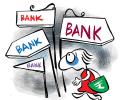
Net profit of 19 listed banks is likely to decline by 4 per cent year-on-year (Y-o-Y) for the quarter ended March (Q4FY25) mainly due to pressure on net interest margins (NIM) as a result of rate cut by the Reserve Bank of India (RBI), according to analysts' estimates. Additionally, loan growth is expected to further slowdown amid low demand in certain secured products, stress in the unsecured segment, and a high cost to deposit (CD) ratio across the system.

State Bank of India was the top gainer in the Sensex pack, climbing nearly 2 per cent, followed by Tata Steel, L&T, Bajaj Finserv, Axis Bank, Bajaj Finance, M&M and ICICI Bank. NSE Nifty surged 112.15 points to 15,834.35.

If he cannot do it this term by using his bureaucracy and experts from different fields, it will be a tragedy, asserts Ramesh Menon.
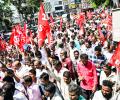
A nationwide strike called by trade unions to protest against the central government's labor policies had a mixed impact across India. While normal life remained largely unaffected in most parts of the country, some sectors like banking, transport, and insurance experienced disruptions. Sporadic incidents of violence were reported in West Bengal.

Equity benchmark Sensex gained 37 points on Thursday, tracking gains in index majors Kotak Bank, L&T and Bharti Airtel amid a largely negative trend in global markets. After a largely choppy session, the 30-share BSE index ended 37.87 points or 0.06 per cent higher at 60,298 after starting the trade on a weak note. During the day, it hit a high of 60,341.41 and a low of 59,946.44.

Banking and capital goods stocks were out of favour, while oil and auto stocks saw buying interest.

Benchmark indices continued to rally for the third day running on Friday with the Sensex climbing 619 points in early trade to reclaim the 57,000 level. The 30-share BSE benchmark jumped 619.27 points to 57,477.06. The broader NSE Nifty advanced 189.15 points to 17,118.75.

The top 100 companies have accounted for 63% of the gains (Rs 51 trillion out of Rs 81 trillion), while firms beyond the top 100 have contributed 37 per cent (Rs 30 trillion).
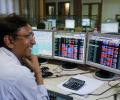
Snapping a six-day losing run, equity indices settled in the green after a highly volatile session on Monday, with the Sensex climbing 237 points amid positive cues from European markets. The BSE benchmark gained 237.42 points or 0.46 per cent to settle at 51,597.84. During the day, it hit a high of 51,714.61 and a low of 51,062.93.

The Gems and Jewellery Export Promotion Council (GJEPC) has urged the Centre to provide immediate relief measures as the tariffs imposed by the United States have started hitting the industry. US tariffs of 50 per cent on Indian goods came into effect on August 27.

'2025 is the year to build a portfolio for the future. Focus this year should be on valuations and visible growth.'
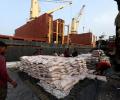
Apex exporters body FIEO on Tuesday expressed serious concerns over high US tariffs on Indian goods and said that textiles and apparel manufacturers in Tirupur, Noida, and Surat have halted production amid worsening cost competitiveness due to these steep duties. The US duties on Indian goods will increase to 50 per cent from August 27.

Maharashtra has topped the list of states with the most favourable ecosystem for the growth of Farmer Producer Organisations (FPOs), replacing Madhya Pradesh, which has slipped to second place, according to the latest Ease of Doing Business for FPOs (EoDBF) ranking.

The plan was to expand further, add more branches and also eventually become the third bank in India to start a wholly owned subsidiary after Singapore's DBS Bank and State Bank of Mauritius, but those plans never materialised due to lack of scale and rising non-performing assets in the country.

Markets investors became richer by Rs 27.10 lakh crore as the BSE benchmark Sensex continued to rally for the sixth trading day, surging nearly 6 per cent during this period. On Monday, the 30-share BSE bellwether gauge jumped 1,078.87 points or 1.40 per cent to settle at an over six-week high of 77,984.38. During the day, the benchmark zoomed 1,201.72 points or 1.56 per cent to 78,107.23.

Sun Pharma, Tata Steel, State Bank of India, Axis Bank, Tata Motors, Larsen & Toubro and ICICI Bank were also among the Sensex gainers. HCL Tech, UltraTech Cement, Nestle and Hindustan Unilever were among the laggards.
'Entering India is exciting, but it's also challenging. You have to be prepared for long-term investment.'

Public sector banks (PSBs) have proposed the Finance Ministry their plan to raise Rs 54,800 crore through Additional Tier-1 (AT-1) and Tier-2 bonds in the current financial year (FY25), 37 per cent more than the Rs 39,880 crore raised in FY24
Telecom firm Bharti Airtel will approach the government on the adjusted gross revenue (AGR) it has to pay the exchequer following the Supreme Court's judgment that the government can reassess all AGR dues, according to vice-chairman and managing director Gopal Vittal.

The change in stance to neutral from accommodative in the June monetary policy meeting does not necessarily signal that the Reserve Bank of India's (RBI's) rate setting body - monetary policy committee (MPC) - will go on a prolonged pause on rate cuts going forward, believe experts.
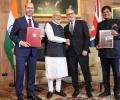
'That way you're not hostage just to US sort of exports to India.'

The liquidity in the banking system moved into surplus almost after three months as the Reserve Bank of India (RBI) absorbed over Rs 40,000 crore from the market on Monday, predominantly on the back of increased government spending. However, this situation may be short-lived given the higher demand for funds to pay taxes and year-end targets, treasury executives said. Meanwhile, two variable reverse repo rate (VRRR) auctions held on Tuesday received weak response.

India's inclusion in JP Morgan's bond index can channel billions of dollars into India. How will the government securities market handle it?

A number of non-banking financial companies (NBFCs) have tapped into the debt capital market ahead of the festival season to meet increasing credit demand as bank funding slows. On Tuesday, Aptus Value Housing Finance secured Rs 300 crore at an interest rate of 8.75 per cent through bonds maturing in five years. ICICI Home Finance Company turned to the market to raise Rs 275 crore at 7.94 per cent, alongside another Rs 300 crore at 7.95 per cent, through bonds maturing in five and three years, respectively.

Benchmark stock indices Sensex and Nifty closed higher for a second straight session on Monday following buying in index majors Reliance Industries, ICICI Bank and recovery in global markets.

The first quarter of calendar 2023 will see new faces heading four large public-sector banks -- Canara Bank, Bank of Baroda, Indian Overseas Bank, and Bank of India.
Their net NPA as a proportion of net advances were 2.2 per cent, compared with 1.7 per during the same period a year earlier.
With inflation comfortably below the Reserve Bank of India's (RBI's) 4 per cent median target and likely to undershoot its 3.7 per cent projection for 2025-26 (FY26), there is room for the monetary policy easing cycle to be sustained, the Finance Ministry said on Monday. The comments, featured in the ministry's Monthly Economic Review for June 2025, assume significance ahead of the Monetary Policy Committee (MPC) meeting of the Reserve Bank of India (RBI) scheduled to begin from August 5.

This is the first tranche of capital infusion for the fiscal and more funds would be provided in future depending upon the performance of PSU banks.
